
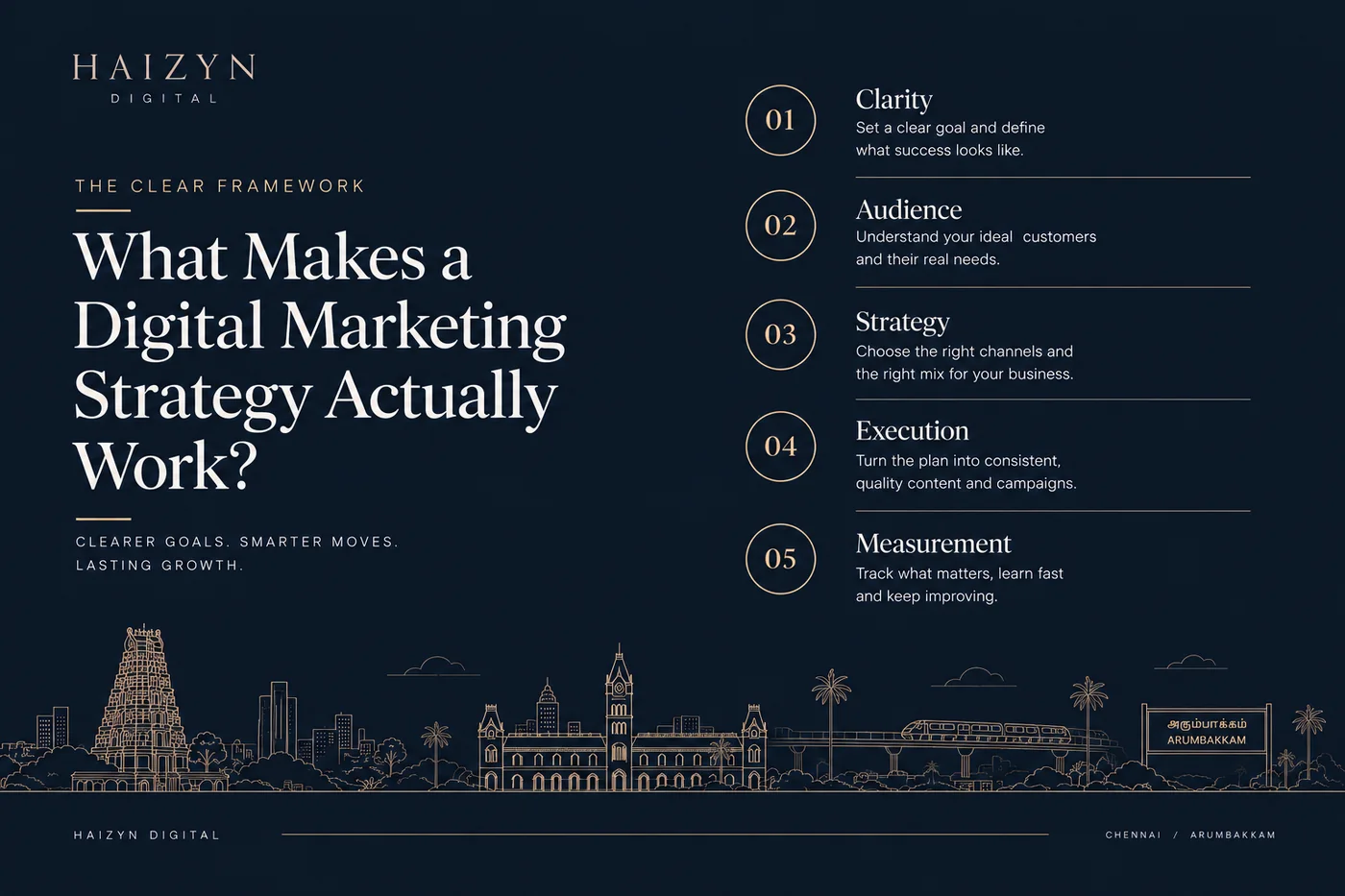
A digital marketing strategy works when it starts with one clear goal, focuses on the right customers, uses the few channels that fit them, sends a simple message, and tracks real results. It is not about being everywhere online. It is about doing the right things on purpose, then improving them steadily.
Most marketing does not fail because the ads are bad or the posts are ugly. It fails because there is no strategy behind them. The business stays busy, tries a bit of everything, and still wonders why nothing sticks. A clear strategy is what turns scattered effort into steady growth.
This guide is written for small business owners, startups, and shops in Arumbakkam and the wider Chennai area. You do not need to be a marketing expert to follow it. By the end, you will know exactly what a working strategy looks like, why most fail, and a simple framework to build your own.
What a Digital Marketing Strategy Really Is
Let us start plainly. A digital marketing strategy is a simple plan for how you will reach the right people online and turn them into customers. It answers three questions. Who do you want to reach? How will you reach them? How will you know it worked?
That is the whole idea. Everything else is detail. Notice what a strategy is not. It is not "let us post on Instagram, run a few ads, and see what happens." That is activity. A strategy gives activity a direction, so your time and money pull one way instead of scattering in ten.
From what we have seen at Haizyn Digital, this is the biggest gap for most small businesses. They post, they boost, they try things. But there is no plan underneath. A clear strategy is what turns that effort into steady results instead of noise.
What is a digital marketing strategy in simple terms?
It is a clear plan for reaching the right customers online and turning them into sales. It sets one goal, picks the channels that fit, shapes a simple message, and decides how you will measure success. In short, it gives your online effort a purpose and a way to check if it is working.
Strategy vs Tactics: The Mix-Up That Wastes Money
Here is the myth that trips up most owners, and it is an expensive one. They think tactics are strategy. Running ads, posting reels, sending emails, doing SEO, these are tactics. They are things you do. Strategy is the thinking that decides which of them to do, and why.
Strategy is the plan. Tactics are the actions. Strategy says, "We need more local leads, so we will focus on Google search and reviews." Tactics are the actual ads, pages, and posts that follow. Do tactics with no strategy, and you stay busy but go nowhere.
| Strategy (the thinking) | Tactics (the doing) |
|---|---|
| Decide the one main goal | Run a Google Ads campaign |
| Choose exactly who to target | Write and post reels |
| Pick the few right channels | Send an email offer |
| Shape the core message | Build a landing page |
| Set how you measure success | Ask for reviews |
The left side rarely changes. The right side changes often. Owners who skip the left side end up rebuilding the right side again and again, wondering why nothing sticks. The strategy is the part that makes the tactics worth doing.
What is the difference between strategy and tactics?
Strategy is the plan; tactics are the actions that carry it out. Strategy decides your goal, audience, and channels. Tactics are the ads, posts, and pages you actually make. Tactics only work when a clear strategy tells them where to aim, otherwise you are just staying busy.
The CLEAR Framework
Here is a simple framework you can use to build any strategy, or to check one you already have. We call it CLEAR. Each step answers a question. If you can answer all five clearly, you have a real strategy, not just activity. If you cannot, you have just found your weak spot.
Clarity
Set one clear goal and define what success looks like. "Get twenty more bookings a month" beats a vague hope to "grow online."
Audience
Understand your ideal customers and their real needs. Know who they are, what they want, and where they look online.
Strategy
Choose the right channels and the right mix for your business. Pick the few that fit your customers, not all of them.
Execution
Turn the plan into consistent, quality content and campaigns. A clear message, done steadily, beats clever done once.
Measurement
Track what matters, learn fast, and keep improving. Watch leads and sales, not just likes, and adjust from there.
How to use CLEAR
Run any plan through these five steps. Here is the insight most people miss: a weak answer anywhere breaks the whole chain. A brilliant message aimed at the wrong audience fails. Perfect channels with no clear goal fail. Good tracking that no one reviews fails. You are only as strong as your weakest step, so fix that one first.
A worked example
Say you run a small salon. Clarity: get twenty more bookings a month. Audience: women nearby who want a trusted, tidy place. Strategy: Google Business Profile, reviews, and Instagram. Execution: steady photos and an easy WhatsApp booking link. Measurement: track WhatsApp bookings each week. Now every post and photo has a job. That is the difference a framework makes.
A Working Strategy vs a Failing One
Two businesses can be equally skilled in real life, yet get very different results online. Often the only difference is the strategy behind the effort. Here is a plain side-by-side.
| A working strategy | A failing one |
|---|---|
| One clear, measurable goal | Vague hope to "grow online" |
| Two or three focused channels | A little of everything, everywhere |
| A simple, clear message | Clever slogans no one understands |
| Tracks leads and sales | Tracks likes and views only |
| Runs steadily for months | Starts and stops every few weeks |
| Improves based on data | Changes on gut feeling or panic |
Look down the right column. None of those mistakes come from a bad business. They come from missing strategy. The good news is that the left column is fully within reach for any small business willing to slow down and plan first.
What separates a good strategy from a poor one?
A good strategy is focused, measured, and given time; a poor one is scattered, unmeasured, and constantly changed. The best strategies do fewer things well and track real outcomes. The weakest ones chase every platform, watch only vanity numbers, and quit before results can build.
Why Most Strategies Fail
Most strategies do not fail from bad luck or a bad market. They fail from a few common patterns. Spot these, and you avoid the biggest traps before they cost you.
No clear goal
A plan aimed at "more growth" has nothing real to hit. Without a single, clear goal, every choice becomes a guess, and you cannot tell success from noise. This is the most common failure of all, and the easiest to fix.
Trying to do everything at once
Spreading across every platform and tactic burns time and money fast. A small business simply cannot do it all well. Two channels done properly beat eight done poorly. Spreading thin feels productive but delivers little.
No patience or consistency
Many owners quit a strategy too soon, or change it every few weeks. Marketing needs steady effort to show results, especially the parts like SEO and content that build over months. Stopping and starting resets your progress each time, so you never get past the slow early stage.
No tracking, or chasing the wrong numbers
Without measuring, you cannot tell what works, so you keep spending on the wrong things. And likes and views feel good but may not bring a single sale. A working strategy tracks the numbers that lead to money, real leads and customers. For more on turning attention into enquiries, see our guide on why local businesses struggle to convert leads. (Google's own conversion tracking guides explain how to count real results.)
Why do digital marketing strategies fail?
Most fail because they lack a clear goal, try to do too much, or are not given time to work. Others fail from no tracking, so no one knows what actually helped. The fix is focus, patience, and measuring real results, instead of chasing every platform and every vanity number.
What Changes for a Local Arumbakkam Business
The steps above apply to any business. But a local business in Arumbakkam or Chennai has one big advantage worth building the whole strategy around: nearness. Your best customers are close by and searching locally. That should shape your plan.
Local search comes first
For a local business, showing up in nearby searches and on Google Maps often matters more than anything else. Your Google Business Profile becomes a central channel, not an afterthought. Keeping it complete, with photos and reviews, is some of the highest-value work a local strategy can include. (See Google's guidance on improving your local ranking.)
Reviews carry extra weight
Locally, word of mouth and reviews do a lot of the selling. People trust what nearby customers say. A steady habit of asking happy customers for reviews, and replying to each one, strengthens both trust and how often you appear. Build this into the strategy, not as an extra.
Match the words people actually use
Local customers search in plain terms, often a service plus a place, like "salon in Arumbakkam." When your pages and listing use those same words, you match the search and show up. A local strategy leans into this, rather than clever wording that no one types.
Is a local marketing strategy different from a general one?
Yes, in emphasis. A local strategy puts more weight on Google Business Profile, reviews, Maps, and plain local search terms, because the best customers are nearby and searching locally. The core steps are the same, but a local business should build the plan around being found and trusted close to home.
How to Build a Strategy That Works
You do not need a thick document. You need clear answers and steady action. Here is a simple path any owner can follow.
- Set one clear goal. Write it in a single sentence you can measure.
- Describe your customer. Who they are, what they want, and where they look.
- Pick two or three channels. Only the ones that fit those customers.
- Write a simple message. What you offer, why it helps, and what to do next.
- Set up tracking. Decide what counts as success, and how you will record it.
- Run it for a set time. Give it a few months of steady effort before judging.
- Review and improve. Keep what works, drop what does not, change one thing at a time.
A simple monthly rhythm
Once it is running, keep a light monthly habit. Check your signals: leads, calls, sales. Look at which channel brought them. Keep the winners, trim the rest, and improve one thing. This steady rhythm, not constant big changes, is what compounds into real growth over a year.
Doing It Yourself vs Getting Help
You can build a basic strategy yourself, and it is worth trying. The real question is where your time is best spent as your business grows.
When doing it yourself works
Doing it yourself works when your goal is simple, your channels are few, and you have time to learn and stay consistent. Starting small teaches you a lot about your own customers, which is valuable knowledge no one can hand you.
When an agency helps
An agency helps when the plan grows complex, when you want ads and SEO done well, or when consistency keeps slipping because you are busy running the business. A digital marketing agency in Arumbakkam like Haizyn Digital helps local businesses build a focused strategy and keep it running, so marketing does not fall to the bottom of the list every week.
Do I need an agency to build a marketing strategy?
Not to start. You can set a goal, pick channels, and track results yourself. An agency helps when you want expert channels, steady management, and a sharper plan, or when you simply lack the time. Many owners begin alone, then bring in help to go further and stay consistent.
Frequently Asked Questions
What makes a digital marketing strategy successful?
A successful strategy has a clear goal, targets the right customers, uses the few channels that fit, and measures real results. It stays focused instead of chasing every platform, and it is given time to work. Focus, consistency, and tracking are what make it succeed.
How long before a strategy shows results?
Some parts, like ads, can bring leads within days. Others, like SEO and content, take a few months to build. A fair test of a full strategy is usually a few months of steady effort. Give it time before judging, but track from day one so you can see progress.
How many channels should a small business use?
Usually two or three, chosen to match where your customers actually are. Trying to do every platform spreads a small business too thin. It is better to run a few channels well than many channels badly.
What is the most important part of a strategy?
A clear, single goal. Everything else, your audience, channels, message, and tracking, flows from it. Without a clear goal, you cannot aim your effort or measure success, so the rest loses direction.
How do I measure if my strategy is working?
Track the numbers that lead to money, such as leads, calls, and sales, not just likes and views. Decide upfront what success looks like, then check regularly. If those real numbers rise over time, the strategy is working.
Can I change my strategy once it is running?
Yes, but improve it rather than abandon it. Give it time, then adjust one thing at a time based on what your tracking shows. Constant big changes reset your progress, while steady, informed tweaks make it stronger.
Key takeaway
A digital marketing strategy works when it is focused, not busy. Start with one clear goal, understand your customer, pick the few right channels, say something simple, and measure what matters. For a local business, build the whole plan around being found and trusted nearby. The businesses that win online are not the ones doing everything. They are the ones doing the right things on purpose, then improving them steadily. Run your plan through CLEAR, fix the weakest step, and give it time.