
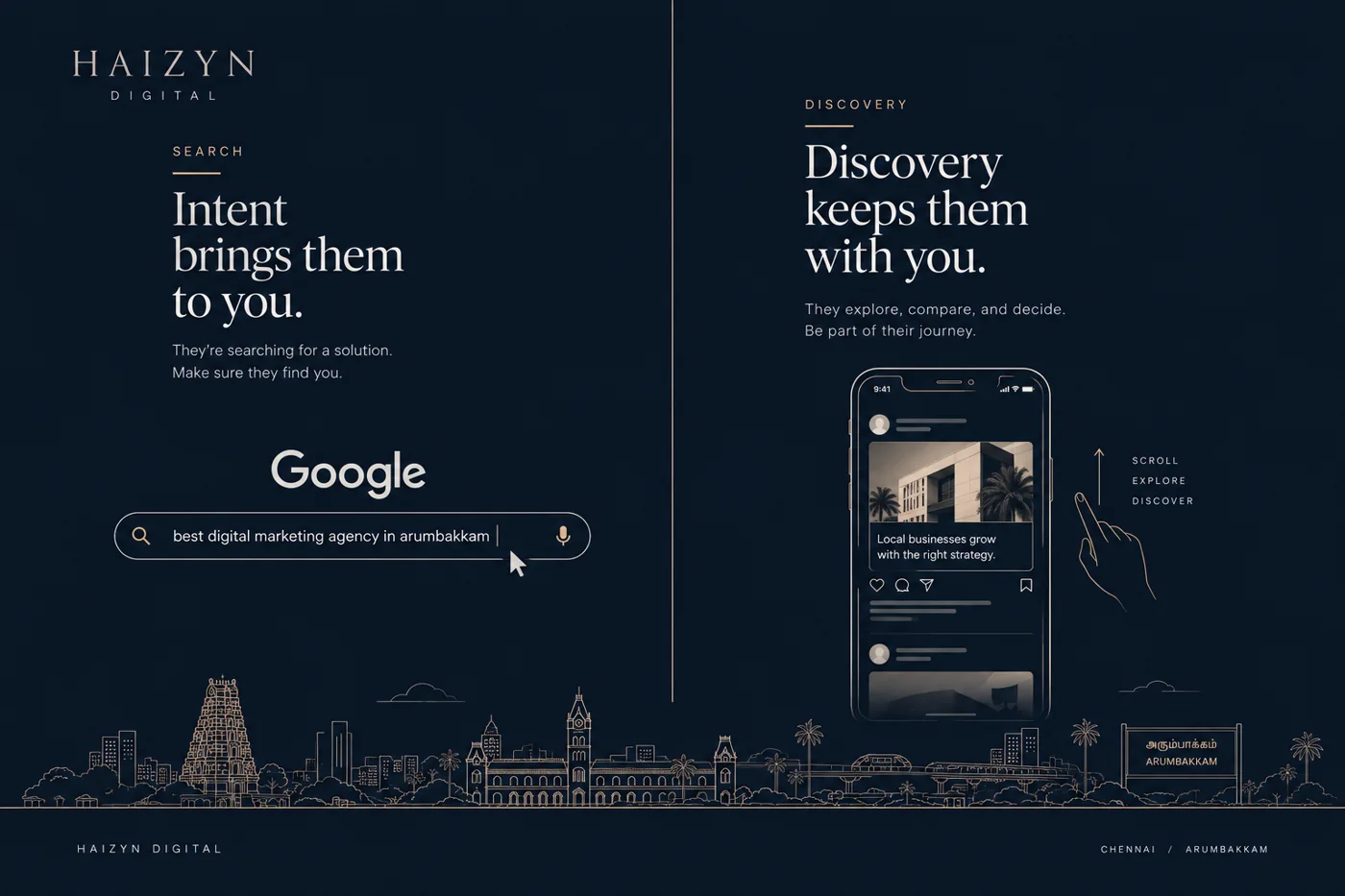
For local businesses, Google Ads is usually better when people are already searching for what you sell, like a plumber or a dentist. Meta Ads are better when you need to create interest, show a product, or build a local following. Most small businesses do best with Google Ads first, then add Meta Ads once they have room to grow.
You have some money set aside for ads. Now you face a simple but hard question. Should you spend it on Google or on Meta? Both promise more customers. Both sound right. And both can waste your money if you pick the wrong one for your goal.
This guide makes the choice clear. It is written for small business owners, startups, and shops in Arumbakkam and the wider Chennai area. You do not need to be a marketing expert to follow it. By the end, you will know how each platform works, which one fits your business, and how to spend your first budget without regret.
We will not push one side. Google Ads and Meta Ads both work. They just work in different ways, for different needs. The trick is matching the tool to your goal. A good digital marketing agency in Arumbakkam does this matching every day, and this article shows you the same thinking.
The core difference: search vs scroll
Here is the single most useful idea in this whole guide. Google Ads reach people who are searching. Meta Ads reach people who are scrolling. That difference shapes everything else.
When someone types “AC repair near me” into Google, they want a fix now. They have a need, and they are looking for a business to meet it. A Google Ad puts you in front of that ready buyer. This is called capturing demand. The demand already exists. You just show up for it.
Meta Ads work the other way. People on Facebook and Instagram are not searching for you. They are looking at photos, videos, and updates from friends. Your ad appears between those posts. You are not meeting a need they typed out. You are creating interest they did not have a minute ago. This is called creating demand.
Why this matters for your money
This one idea decides where your budget works hardest. If people already search for your service, Google helps you catch them at the right moment. If people do not know they need you yet, Meta helps you introduce yourself. Think of it like a market. Google is the stall you set up where shoppers are already walking with a list. Meta is the sign you put on a busy road to make drivers curious.
Should a new local business start with Google or Meta?
Most new local businesses should start with whichever platform matches how their customers behave, and for many that means Google. If people already search for your service, Google brings ready buyers from day one. If your product is visual and discovery-led, Meta is the better first step. Start with one, learn what works, and add the second later rather than splitting a small budget across both at once.
How Google Ads works for a local business
Google Ads show your business at the top of Google when people search for words you choose. You only pay when someone clicks your ad. This is why it is often called pay-per-click. For a local business, this is powerful. You can show up exactly when a nearby person searches for what you offer. (See the Google Ads Help Center.)
The main types you will use
- Search ads: text ads at the top of search results. Best for catching ready buyers.
- Maps and local ads: your business on Google Maps and in local results. Great for shops and services people visit.
- Display ads: image ads on other websites. Useful for reminders, less for instant sales.
The strength: high intent
The big win with Google Ads is intent. The person is already looking. That means clicks are more likely to turn into calls, visits, or sales. You are not convincing someone from scratch. You are answering a question they just asked.
Keywords are the whole game
With Google Ads, your keywords decide who sees you. A keyword is the word or phrase a person types. Pick words that show real buying intent, like “emergency plumber Arumbakkam,” not vague ones like “plumbing tips.” Just as important are negative keywords. These are words you tell Google to ignore, so your ad does not show for them. If you sell new cars, you might block “free” or “used.” Good keyword choices, plus a tidy list of negatives, are often the difference between a Google campaign that pays and one that drains.
How Meta Ads works for a local business
Meta Ads run on Facebook and Instagram. They appear in feeds, stories, and reels while people scroll. You can target people by location, age, interests, and more. (See the Meta Business Help Center.)
The strength: attention and discovery
Meta is built for discovery. It is strong when your product looks good, tells a story, or sparks a feeling. A cafe, a salon, a boutique, or a gym can shine here. You show the experience, and people want it. You also build a following you can reach again later.
Creative and retargeting matter most
On Meta, your creative is your salesperson. A clear photo, a short video, and a simple line of text do more than clever targeting. Show the product in use. Keep it real, not overly polished. Meta also lets you do something powerful called retargeting. This means showing ads again to people who already visited your website or watched your video. These people know you a little, so they are more likely to act. Retargeting is often the best-value part of Meta for a local business.
Google Ads vs Meta Ads: side by side
| Factor | Google Ads | Meta Ads |
|---|---|---|
| Who you reach | People searching for you | People scrolling their feed |
| Buyer intent | High (active need) | Lower (discovery) |
| Best for | Services people search for | Products that look or feel good |
| Speed of results | Fast, when demand exists | Fast for reach, slower for sales |
| Main skill needed | Right keywords and landing page | Strong images, video, targeting |
| Builds an audience | Less so | Yes, followers you can reach again |
| Brand awareness | Limited | Strong |
| Local visits and calls | Strong (Search + Maps) | Good with local targeting |
No column wins outright. If you sell a searched-for service and want calls this week, Google leads. If you sell something visual and want to build local awareness, Meta leads. Many businesses use both, in a mix that fits their budget. The best platform is simply the one that reaches your customer in the way they already behave.
The Intent Test: choose your first platform
Here is an original, simple framework you can use today. We call it the Intent Test. Answer three questions. Your answers point to the right first platform.
Question 1: Do people search for what you sell?
Ask if a customer would type your service into Google. Words like “electrician near me” or “best biryani in Arumbakkam” show real search demand. If yes, Google Ads is a strong first choice.
Question 2: Is your product visual or emotional?
Ask if your product looks good in a photo or video, or sparks a feeling. Food, fashion, fitness, beauty, and events all do well here. If yes, Meta Ads help you show it off and create desire.
Question 3: Do you need sales now, or awareness over time?
If you need enquiries this week, lean Google, because it meets ready buyers. If you want to build a local name and a following over months, lean Meta. Your timeline matters as much as your product.
Count your leanings. Two or three answers pointing to Google means start with Google. Two or three pointing to Meta means start with Meta. A split result means you likely benefit from both.
Which platform fits which business: real examples
These are common local business types and where they usually start. They are patterns, not rules, but they show the thinking in action.
A dentist or clinic
Start with Google. People search “dentist near me” when they have a need, often urgent. Google catches them at that moment. Meta can help later for awareness.
A cafe, bakery, or restaurant
Start with Meta. Food is visual and emotional. A short video of a fresh dish can pull nearby people in. A little Google spend catches those who search “cafe near me.”
A gym or boutique
Lean Meta. Gyms and fashion sell on inspiring photos and reels that build desire and a local following. A small Google campaign catches the few who search by name or category.
A plumber, electrician, or repair service
Start with Google, strongly. People rarely scroll for a plumber, but they search for one the moment a pipe bursts. Search and Maps ads put you first at that exact moment.
When to run both, and how to split a small budget
Many local businesses do best using both platforms. Google catches ready buyers. Meta builds awareness and brings them back. The question is how to split a small budget without spreading it too thin.
Start with one, then add the second
If your budget is small, do not split it in half on day one. Pick your winner from the Intent Test and put your money there first. Once that platform runs well, add the second with a smaller test budget. One strong channel beats two weak ones.
A quick way to think about splitting
Picture your monthly ad budget as ten coins. If you run a searched-for service, place six or seven coins on Google, two or three on Meta, and keep one aside to test a new idea. If you run a visual, discovery-led business, flip it. After a month, move coins toward the platform that brought the cheaper enquiries.
How to measure which platform wins
Once your ads run, one number settles most debates: cost per enquiry. It tells you how much you pay for each real lead, like a call or a form fill. It cuts through vanity numbers and shows you the truth.
Focus on cost per enquiry, not clicks
A click is not a customer. To find your cost per enquiry, divide what you spent by the number of real enquiries. If Google costs less per enquiry for your business, put more there. If Meta wins, shift that way.
Track the full path
Some enquiries do not happen on the first click. A person may see your Meta ad, then search your name on Google a week later, then call. If you only look at the last click, you may undervalue the ad that started it all.
How do I know if my ads are working?
Your ads are working if they bring enquiries at a cost you can afford, not just clicks or likes. Track calls, form fills, and bookings, then compare the cost per enquiry across platforms. If a rupee spent brings back more than a rupee in value over time, the ad is doing its job. If not, change the targeting, the creative, or the landing page.
Common ad mistakes local businesses make
Sending clicks to a weak page
An ad is only half the job. If your ad sends people to a slow or confusing page, you lose them. The page should match the ad, load fast, and make the next step obvious, like a call button or a short form.
Targeting too wide, or judging by clicks alone
Showing your ad to everyone wastes money. Narrow your area, and speak to the people most likely to buy. And remember clicks are not sales. Track calls, form fills, and bookings so you know which ad truly works.
Ignoring mobile users
Most local searches and most feed scrolling happen on phones. If your landing page is hard to use on a phone, you lose most of your visitors. Check every ad and page on a phone first. A tap-friendly call button often matters more than the ad itself.
Where organic fits alongside ads
Ads are not the whole picture. They bring quick traffic, but they stop the moment you stop paying. Organic channels, like search engine optimization and your Google Business Profile, keep working in the background without a cost per click.
The smartest local plan usually runs both together. Ads bring enquiries today while your organic presence grows. Over months, strong local SEO and a well-kept profile can bring steady enquiries that lower your reliance on paid clicks. Ads and organic feed each other, so run them as one team, not two.
How to start in one week and measure success
- Day 1 — Set one clear goal. For example, “get more calls from people near Arumbakkam.”
- Day 2 — Run the Intent Test. Pick your first platform based on your three answers.
- Day 3 — Prepare the destination. Make sure the page or profile people land on is fast, clear, and has an easy next step.
- Day 4 — Set up tracking. Turn on conversion tracking so every call and form is counted.
- Days 5–7 — Launch small and watch. Start with a modest daily budget. Check daily for the first week, then weekly.
In the first few weeks, do not expect a flood. Look for signs of health: clicks at a fair cost, some real enquiries, and clear tracking. Then improve one thing at a time. You can start ads yourself, and many owners do. Bring in help when spending rises or results stall. This is where a digital marketing agency in Chennai earns its keep, and the best digital marketing agency in Arumbakkam will show you the numbers plainly, so you always know what your money is doing.
Frequently asked questions
Which is cheaper, Google Ads or Meta Ads?
There is no fixed answer, because cost depends on your industry, your area, and how many others are bidding. Meta clicks are often cheaper, but Google clicks often come from people ready to buy. The smarter question is which brings better enquiries for the money you spend.
Can I run Google Ads and Meta Ads at the same time?
Yes, and many local businesses do. Google catches people who are already searching, while Meta builds awareness and brings them back. If your budget is small, start with one platform, learn what works, then add the second with a small test budget.
How much should a local business spend on ads to start?
Start with an amount you are comfortable testing for a month, not your whole budget at once. A small, steady daily budget lets you learn without risk. Once you see which ads bring real enquiries, put more money behind the winners and cut the rest.
How long before ads bring results?
Google Ads can bring enquiries within days when demand exists, because you reach ready buyers. Meta Ads can build reach quickly, but sales often take longer as people warm up. In both cases, give your ads a few weeks of tuning before you judge them.
Do I need a website to run ads?
For Google Ads, a good landing page helps a lot, because clicks need somewhere useful to go. For Meta Ads, you can send people to your profile, a form, or WhatsApp, though a strong page still helps. Either way, the destination must be fast and clear.
Should I hire an agency or run ads myself?
You can start ads yourself, especially with a small budget and simple goals. Hire help when spending grows, when results stall, or when the work takes more time than you have. A good agency saves money by avoiding common mistakes and focusing spend where it works.
Key takeaway
Google Ads and Meta Ads are not rivals. They are two tools for two jobs. Use Google Ads to catch people who are already searching for what you sell. Use Meta Ads to create interest and build a local following. Run the Intent Test, start with one platform, track real enquiries, and shift your budget toward what works. Match the tool to your goal, and your ad money will finally pull its weight.