
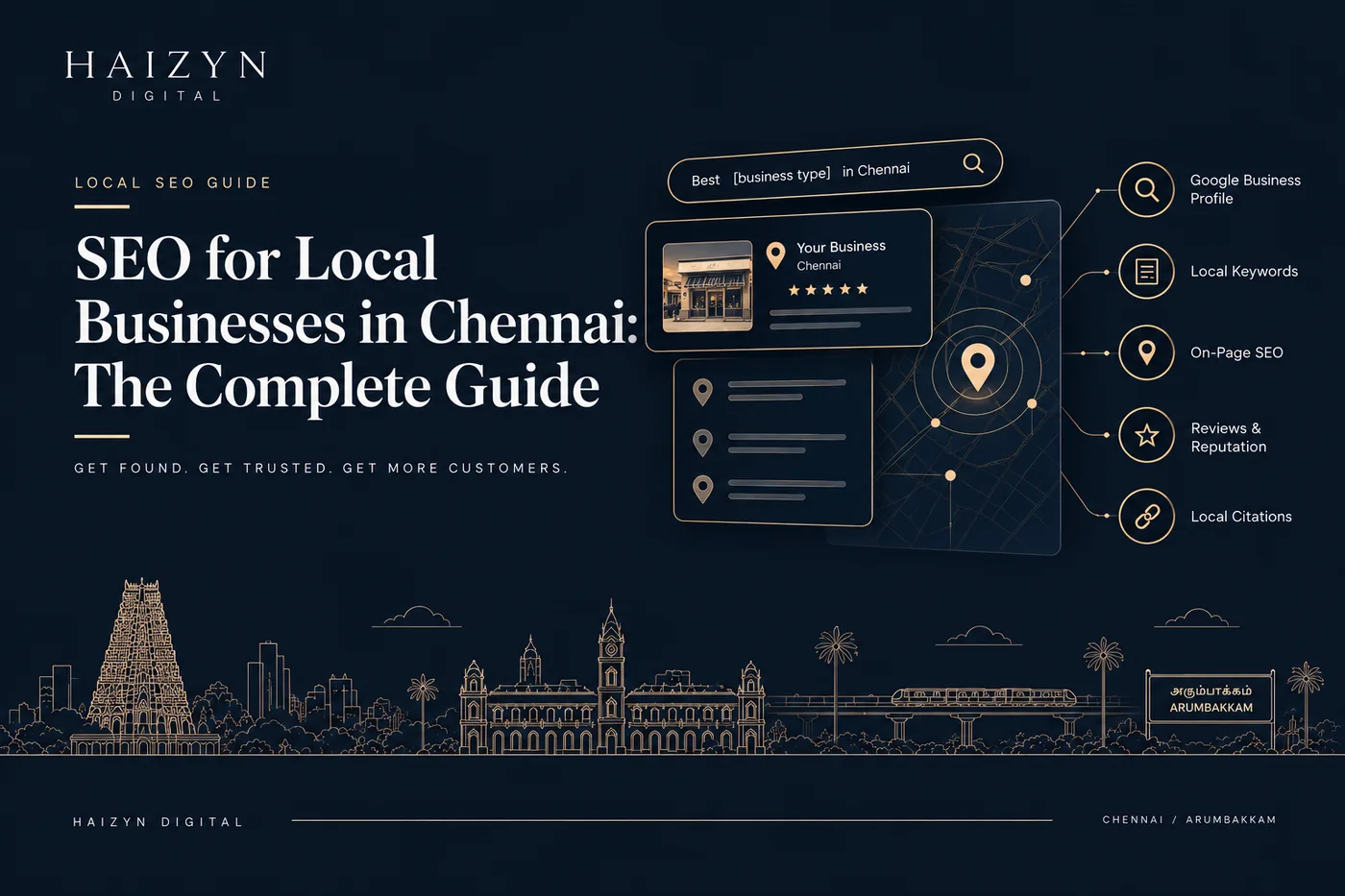
SEO for local businesses in Chennai means helping nearby customers find you on Google when they search for what you offer. It works by fixing your website, completing your Google Business Profile, earning reviews, and using the plain words people search. Done well, it brings steady enquiries from people close enough to become customers, without paying for every click.
Every day, people across Chennai pull out their phones and search for a service near them. A salon, a clinic, a plumber, a cafe. If your business shows up, you get the call. If it does not, your competitor does. That is what local SEO decides.
This guide explains local SEO in plain terms, for small business owners in Arumbakkam and the wider Chennai area. You do not need to be technical. By the end, you will know how local search works, what to fix first, and a simple framework to climb the results steadily.
What Local SEO Really Is
Let us keep this simple. SEO stands for search engine optimization. It means making changes so your business shows up higher on Google's free results when people search. Local SEO is the same idea, aimed at nearby searches.
The word "free" matters here. Unlike ads, you do not pay Google for each click from search. You earn the spot by being relevant, trusted, and clearly local. That takes work and time, but the traffic keeps coming without a cost per click.
From what we have seen, most local businesses have huge room to improve here, often just by fixing the basics. Local SEO is rarely about clever tricks. It is about doing the plain, important things well and keeping them up.
What is local SEO in simple terms?
Local SEO is the work of helping nearby customers find your business on Google's free results and map. It includes completing your Google Business Profile, earning reviews, fixing your website, and using the words people search. The goal is steady enquiries from people close enough to visit or call.
How Local Search Works in Chennai
To rank well, it helps to know what Google is trying to do. When someone searches locally, Google tries to show the businesses most relevant, closest, and most trusted for that search. Get those three right, and you rise.
The map pack and the blue links
A local search often shows two things: a map with a few businesses on top, called the map pack, and the usual list of website links below. The map pack gets a lot of the calls and directions, so appearing there is a big win. Your Google Business Profile decides whether you show up in it.
The three things Google weighs
Google's own guidance points to three main factors for local results: relevance, distance, and prominence. Relevance is how well you match the search. Distance is how close you are. Prominence is how well-known and trusted you seem, partly through reviews. You can read this in the Google guide on improving your local ranking.
What this means for you
You cannot move your shop closer to everyone, but you can win on relevance and prominence. That means being crystal clear about what you do and where, and building a steady flow of reviews and trust. Those are the levers within your control.
How does Google decide local search rankings?
Google mainly weighs three things for local results: relevance, distance, and prominence. Relevance is how well you match the search, distance is how close you are, and prominence is how trusted and known you seem, partly through reviews. You can influence relevance and prominence the most, so focus your effort there.
The Four Layers of Local SEO
Local SEO has four layers that build on each other. Skip a lower layer, and the higher ones cannot hold. Build them in order.
Layer 1: Technical foundation
This is your website's health. It should load fast, work well on phones, be secure, and be easy for Google to read. If your site is slow or broken on mobile, nothing above this layer works properly. Fix the foundation first. Google's SEO Starter Guide covers the basics.
Layer 2: Relevance (on-page)
This is making each page clearly say what you do and where. Use plain words your customers search, like "dentist in Arumbakkam," in your page titles, headings, and text. Clear beats clever. If a page is vague, Google cannot match it to searches.
Layer 3: Authority (content and links)
This is trust. Helpful content, like guides and answers to common questions, shows you know your work. Links from other trusted local sites and directories act like votes for you. Together they lift your prominence over time.
Layer 4: Local signals (profile and reviews)
This is the layer that matters most for local search. Your Google Business Profile, your reviews, and your consistent business details tell Google you are a real, trusted local business. This layer often decides the map pack.
What are the most important parts of local SEO?
The most important parts are your Google Business Profile, reviews, and clear, plain website pages that say what you do and where. A fast, mobile-friendly site sits underneath as the foundation. For local search specifically, your profile and reviews usually carry the most weight.
The LOCAL Framework
Here is a simple framework you can use to build or check your local SEO. We call it LOCAL. Each step is a job. Do all five, in order, and you cover everything that matters without getting lost in jargon.
Listing
Claim and complete your Google Business Profile — correct name, address, phone, hours, category, and photos. This is the foundation of local search.
Optimise
Make your website clear and fast. Use plain, local words on your pages, and make sure it works well on phones.
Content
Publish helpful pages and answers to the questions your customers ask. Useful content builds trust and brings search traffic.
Authority
Earn reviews and links from trusted local sources. These act as votes that lift how prominent you seem to Google.
Longevity
Keep it up. Post, gather reviews, and refresh pages steadily. Local SEO rewards consistency over months, not one-time effort.
How to use LOCAL
Go through the five steps in order. The insight most people miss is the last one, Longevity. Many businesses do the first four once, then stop, and slowly slide down. Local SEO is a habit, not a project. The businesses that keep showing up are the ones that keep working at it.
Your Google Business Profile: The Biggest Lever
If you do one thing from this guide, do this. For local search, your Google Business Profile is the single biggest lever you have. It is free, and it often decides whether you appear on the map at all.
Complete every field
Fill in everything: name, address, phone, hours, category, services, and a clear description. A complete profile tells Google you are real and active. Half-filled profiles get skipped for fuller ones.
Add real photos, and keep them fresh
Upload real, recent photos of your space, team, and work. Photos build trust with searchers and signal an active business to Google. Refresh them now and then rather than leaving them frozen in time.
Gather and answer reviews
Reviews are part of ranking, not just trust. Ask happy customers to leave one, and make it easy with a link. Reply to every review, kind or critical, in a calm voice. A steady flow of genuine reviews is one of the strongest local signals there is.
Keep your details identical everywhere
Your name, address, and phone should match exactly across Google, your website, and any directory. Mismatches confuse Google and lower trust. Consistency is quiet but powerful.
How do I rank higher on Google Maps?
Complete your Google Business Profile fully, add real photos, and gather genuine reviews while replying to each one. Keep your name, address, and phone identical everywhere, and use accurate categories. These local signals, paired with a clear website, are what lift you in the map results over time.
Common Local SEO Mistakes
A few habits quietly hold local businesses back. Avoid these and you are ahead of most.
An unclaimed or thin profile
Leaving your Google Business Profile unclaimed or half-empty is the most common and costly mistake. It is free to fix and often brings the fastest gains.
Vague website wording
Clever taglines that never say what you do, or where, confuse both people and Google. Say it plainly: your service and your area, in normal words.
Ignoring reviews
Never asking for reviews, or never replying, weakens a key ranking signal. A simple, steady habit of asking and replying changes this fast.
A slow, mobile-unfriendly site
Most local searches happen on phones. A slow or clumsy mobile site loses visitors and hurts ranking. Speed and mobile ease are not optional.
Doing it once, then stopping
Local SEO is not a one-time task. Businesses that set it up and walk away slide down as others keep working. Steady effort is what holds a ranking.
Why is my business not ranking on Google?
Usually because your Google Business Profile is incomplete, your website is unclear or slow, or you have few reviews. Inconsistent business details across the web hurt too. Complete your profile, clarify your pages, gather reviews, and keep your details identical everywhere to start climbing.
How Long Local SEO Takes
Let us be honest about time, because false promises cause most disappointment. Local SEO is a slow build, not an instant switch. But some parts move faster than others.
Fast wins
A completed, optimised Google Business Profile can start showing you in local results within days to a few weeks. This is the quickest part, which is why it comes first.
The slower build
Ranking your website pages, building authority, and earning trust take longer, often a few months of steady work. This is normal. Anyone promising the top spot in days is not being straight with you.
What good progress looks like
In the first weeks, look for a fuller profile, a few fresh reviews, and a faster site. Over months, expect more map appearances, more calls, and pages that start ranking. Steady upward movement, not overnight jumps, is the healthy pattern.
How long does local SEO take to work?
A completed Google Business Profile can bring results within days to a few weeks, while deeper website ranking usually takes a few months of steady work. Local SEO is a lasting build, not an instant fix. Anyone promising the top spot in days is overpromising.
How to Start in 30 Days
You do not need to do everything at once. Here is a simple, focused first month that follows the LOCAL framework.
- Week 1 — Claim and complete your profile. Fill every field, add photos, set correct hours and category.
- Week 1 — Fix your business details. Make name, address, and phone identical everywhere online.
- Week 2 — Clarify your website. Say plainly what you do and where, using words customers search.
- Week 2 — Check speed and mobile. Make sure your site loads fast and works well on phones.
- Week 3 — Start gathering reviews. Ask recent happy customers, and reply to every review.
- Week 4 — Publish one helpful page. Answer a common customer question in plain language.
- Ongoing — Keep it up. A little every week beats a burst then silence.
Do it yourself or get help
You can do all of the above yourself, and you should start now. Deeper work, like technical fixes, steady content, and link building, takes more time and skill. This is where a digital marketing agency in Arumbakkam like Haizyn Digital helps local businesses build and keep their rankings without it eating their week. Local SEO also works best as part of a wider plan, which we cover in what makes a digital marketing strategy work.
Frequently Asked Questions
What is local SEO?
Local SEO is the work of helping nearby customers find your business on Google's free results and map. It includes your Google Business Profile, reviews, clear website pages, and consistent business details. The goal is steady enquiries from people close enough to visit or call.
How much does local SEO cost?
Many of the basics are free, like claiming your profile and asking for reviews. Costs come in if you hire help for content, technical fixes, or ongoing management. Start with the free basics, then invest once you see what moves the needle for your business.
Is a Google Business Profile enough on its own?
A strong profile is the biggest single lever, but it works best with a clear, fast website and steady reviews. On its own it can bring real results, especially for map searches. Paired with the other layers, it performs far better and holds longer.
Can I do local SEO myself?
Yes, the basics are very doable: claim your profile, add photos, ask for reviews, and clarify your website. Deeper work like technical fixes and content takes more time and skill. Many owners start alone, then bring in help to go further.
Do I need SEO if I run ads?
Yes, because they do different jobs. Ads bring quick traffic but stop when you stop paying. SEO builds lasting visibility that keeps working over time. Running both together covers the short term and the long term.
How do reviews affect local SEO?
Reviews affect both trust and ranking. A steady flow of genuine reviews, with replies, signals to Google that you are an active, trusted local business. They can lift how often you appear in the map results, so asking for them is well worth the habit.
Key takeaway
Local SEO decides whether nearby customers find you or a competitor. You do not need tricks, you need the basics done well and kept up: a complete Google Business Profile, genuine reviews, a clear and fast website, and consistent details everywhere. Build the four layers in order, follow the LOCAL framework, and treat it as a steady habit, not a one-time task. Do that, and your business earns a reliable flow of local customers from search, without paying for every click.